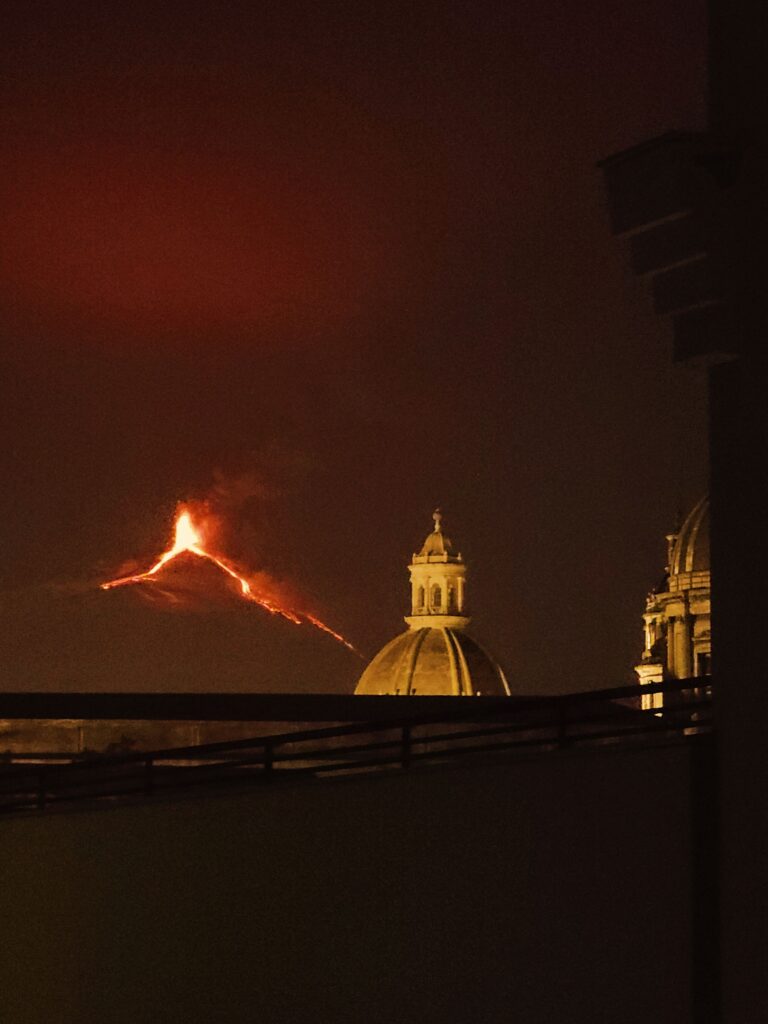
The repeated suspensions and operational restrictions affecting Catania-Fontanarossa Airport in August 2026, as a result of Mount Etna’s volcanic activity and the presence of volcanic ash, have once again brought into focus the passenger rights regime established by Regulation (EC) No 261/2004.
The particular nature of the event requires a clear distinction between the possible exemption of the air carrier from the obligation to pay compensation and the obligations of reimbursement, rerouting and care that continue to apply in respect of affected passengers.
Volcanic activity and the possible exemption from compensation
For the purposes of the exemption from compensation provided for under Article 5(3), Regulation (EC) No 261/2004 does not rely on the concept of “force majeure”, but instead refers to the autonomous concept of EU law of “extraordinary circumstances”.
The Court of Justice of the European Union (“CJEU”) has already directly addressed the effects of volcanic eruptions on air traffic. In Case C-12/11, McDonagh v Ryanair, concerning the closure of part of European airspace following the eruption of the Icelandic volcano Eyjafjallajökull, the Court held that an event of this nature constitutes an “extraordinary circumstance” within the meaning of the Regulation.
Similarly, the presence of volcanic ash and the resulting restrictions or closures of airspace imposed for safety reasons are, in principle, events which are not inherent in the normal exercise of the air carrier’s activity and are beyond its actual control.
This does not mean, however, that every cancellation or delay occurring during such an emergency automatically excludes the right to compensation under Article 7 of the Regulation, amounting, depending on the distance of the flight, to EUR 250, EUR 400 or EUR 600. Pursuant to Article 5(3), the air carrier must demonstrate not only the existence of extraordinary circumstances, but also that those circumstances actually caused the cancellation or delay of the flight concerned and that their consequences could not have been avoided even if all reasonable measures had been taken.
This principle is well established in the case-law of the CJEU and has recently also been reaffirmed by the Italian Supreme Court of Cassation. In particular, in Orders No. 9002 of 9 April 2026 and No. 20489 of 17 June 2026, the Third Civil Division stressed the need for specific evidence both of the extraordinary circumstance and of the causal link with the individual flight, a generic reference to an external event or its alleged “knock-on effects” being insufficient.
The obligations of reimbursement, rerouting and care remain applicable
Extraordinary circumstances may affect the carrier’s obligation to pay compensation, but they do not remove the additional rights granted to passengers under Articles 8 and 9 of the Regulation.
In the event of cancellation, the carrier must first offer passengers a choice between reimbursement of the ticket price and rerouting to their final destination, under comparable transport conditions, at the earliest opportunity. Alternatively, passengers may choose rerouting at a later date at their convenience, subject to the availability of seats.
The CJEU has also clarified that, for the purposes of taking the reasonable measures required by the Regulation, an air carrier cannot, in principle, restrict its assessment solely to its own flights, but must also consider alternative solutions operated by other carriers, unless doing so would constitute an intolerable sacrifice in the light of the carrier’s capacities. In Case C-74/19, Transportes Aéreos Portugueses, the Court held that the reasonable measures required of the carrier may include consideration of direct or indirect alternative flights operated by other air carriers, unless no seats are available or such a solution would impose an intolerable sacrifice on the carrier having regard to the capacities of the undertaking at the relevant time.
Specific rules also apply where a flight is diverted to an alternative airport. Where the flight lands at an airport other than the one originally scheduled, but serving the same town, city or region, Article 8(3) requires the carrier to bear the cost of transferring passengers from the alternative airport either to the airport for which the booking was made or, subject to agreement with the passenger, to another nearby destination. In Case C-826/19, Austrian Airlines, the CJEU clarified that the carrier must offer such onward transport on its own initiative.
A different situation arises where, following a cancellation, rerouting is arranged from a different airport. In that case too, the solution offered must ensure the effective exercise of the right to rerouting under comparable transport conditions, without unduly shifting onto the passenger the costs necessary to implement the alternative arrangement. The specific arrangements must, however, be assessed in light of the particular rerouting solution offered.
Vouchers, failure to provide care and other practical issues
An air carrier may not unilaterally impose a voucher instead of monetary reimbursement. Reimbursement in the form of travel vouchers requires the passenger’s free and informed choice, as clarified by the CJEU in Case C-76/23, Cobult UG v TAP Air Portugal SA.
Where the carrier fails to provide the required care, passengers may make their own arrangements and subsequently seek reimbursement of the expenses incurred, provided that such expenses are necessary, appropriate and reasonable and are duly documented.
The obligations laid down by the Regulation apply to operating air carriers falling within its scope, irrespective of their business model and therefore without distinction between traditional and low-cost carriers.
In conclusion, a volcanic eruption may, where the relevant conditions are met, exclude the carrier’s obligation to pay compensation. It does not, however, exclude the passenger’s rights to information, reimbursement or rerouting and to the care provided for under EU law.